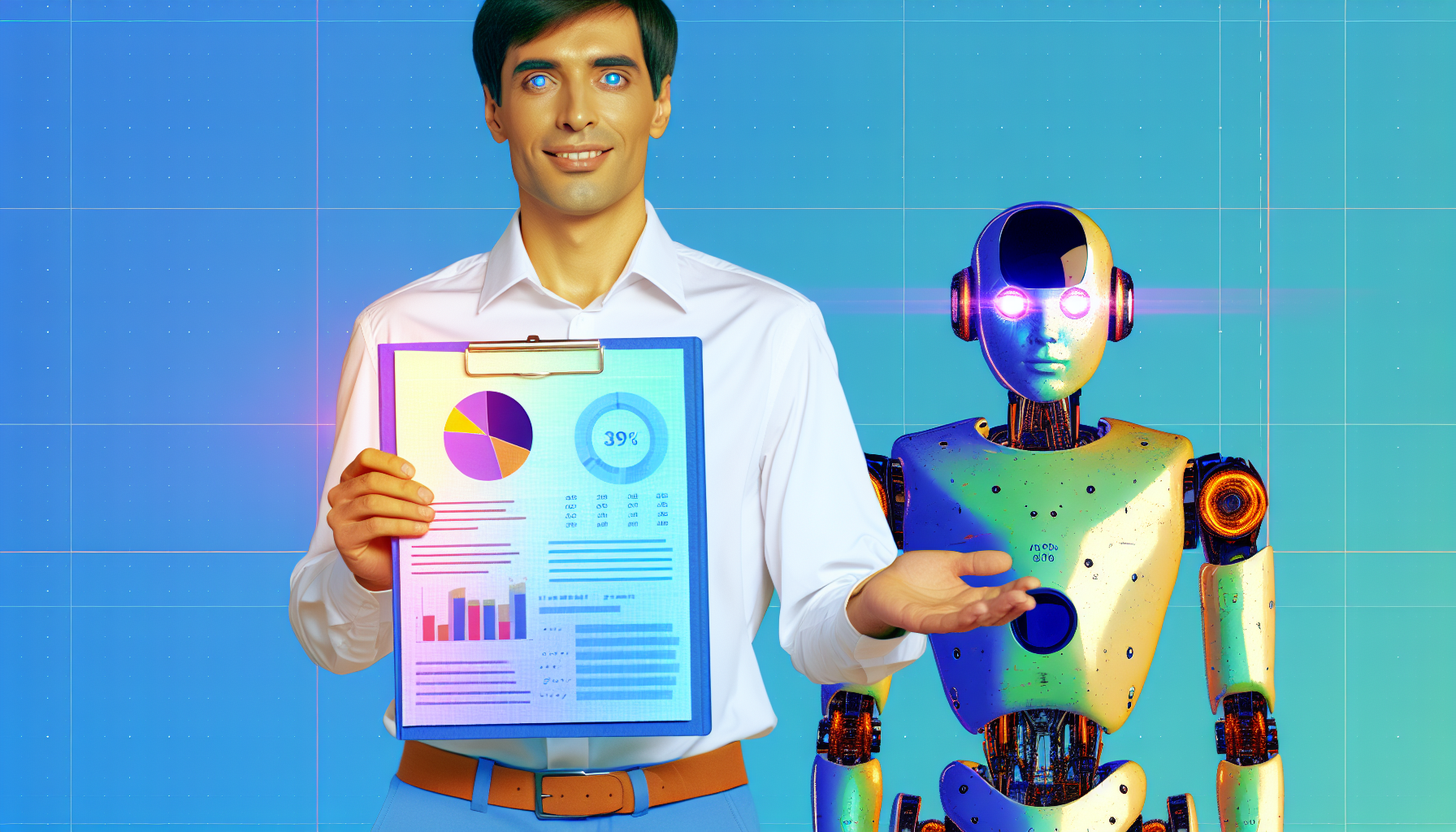
Ever stared at two decisions like a deer caught in a VC pitch? Decision-making is hard—especially when your startup feels like juggling flaming chainsaws. Enter AI-powered decision-making: a tech buddy that crunches numbers, spots trends, and reduces sleepless nights caused by questionable founder ‘gut instincts.’ Whether it’s prioritizing features or nailing user acquisition strategies, AI can help you make smarter, data-backed calls—and maybe even reclaim some of that lost sanity.
When in Doubt, Ask the Robot Overlord

Gone are the days where strategic decisions were made by throwing dice or dowsing the business landscape with a witching stick. Enter the age of artificial intelligence—a time when startup founders can sit back, relax, and ask their ‘robot overlord’ for sage advice on the most intricate business dilemmas.
Consider this: traditionally, a startup’s direction might be dictated by gut instincts or the mysterious art of market ‘intuition.’ This old-school technique could certainly land some wins, but more often than not, it was akin to navigating a minefield blindfolded. However, with AI’s deep learning capabilities and vast data processing prowess, decision-making has morphed into a far more precise science.
Take, for instance, the task of identifying the startup’s target audience. The traditional method might involve some guesswork based on superficial market research or perhaps just an educated guess. Now, imagine wielding the power of AI analytics, which sifts through vast amounts of data to pinpoint demographic sweet spots and consumer behavior patterns with surgical accuracy. Neutral networks and machine learning algorithms parse data at a speed and accuracy that manual analysis could hardly dream of, optimizing marketing strategies and drastically reducing trial-and-error cycles.
Or consider revenue forecasting—previously a territory where ‘maybe,’ ‘possibly,’ and ‘we hope so’ often took up residence. AI introduces a game-changing angle here. Predictive models analyze historical data, market trends, and global economic indicators to churn out forecasts that are not just better informed but also astonishingly precise. This capability allows startups to plan with a higher degree of confidence and tackle financial planning with the finesse of a seasoned chess master.
The efficiency introduced by AI isn’t just confined to robot-like operations. It extends to an almost clairvoyant level of business intelligence. Where earlier the challenge was ‘finding the right answers,’ now it’s often ‘asking the right questions to your AI tools.’ This shift brings about a palpable change in how decisions are made—swiftly, smartly, and with a lot fewer regrets.
Startup founders who integrate AI into their decision-making not only leapfrog over older, more cumbersome methods but also gain a distinct competitive advantage. They spend less time in boardrooms over hot debates and more time steering their venture toward its goals with cool, calculated inputs from their AI systems.
In this brave new world of data-driven strategy, the whims of intuition are replaced by the reassuring confidence of analytics. For more insights into how AI is redefining business processes, check out this additional resource. As we march forward, the guesswork of yesteryears will increasingly seem like a quaint, if not an entirely obsolete, form of decision-making.
Why Second-Guessing Your AI is Like Backseat Driving a Tesla

Imagine you’re cruising in a Tesla, basking in the glory of autopilot ease. Now, picture intervening— twitching at the steering wheel every minute, overriding the meticulous calculations of this engineering marvel. This scenario is analogous to startup founders’ hesitation to trust AI-powered decisions. Just like backseat driving, micromanaging AI undermines its effectiveness, in turn slowing down the potential speed of business advancements.
The reluctance largely stems from a deep-rooted human desire to stay in control, especially when it concerns critical aspects such as financial predictions or hiring decisions. It’s tempting for founders to want to apply human logic over machine efficiency, akin to shouting directions from the backseat, but is it necessary? Financial forecasting, for instance, is driven by data that an AI system can analyze with far greater accuracy and speed. By stepping off the pedal and allowing AI to foresee market trends or cash flow issues, founders can avoid the proverbial crash of bankruptcy or missed opportunities.
In customer behavior analytics, AI thrives on the nuances of data harvesting and pattern recognition—tasks it is tailor-made for. Letting AI control this wheel means gaining insights that are not always intuitive to the human mind. For instance, it might predict a surge in demand (beforehand) in a demographic founders hadn’t considered, which could influence marketing strategies or inventory decisions. Trusting AI here can be compared to letting the Tesla take the fastest route suggested by its uber-efficient GPS, rather than the familiar backroads.
Hiring decisions can also benefit from AI intervention. Traditional methods may lean towards gut feeling or familiarity with candidates. However, AI-driven tools analyze myriad data points from past hiring outcomes to the minutest details in resumes, ensuring a less biased and more qualitative assessment. It’s like choosing a driver based on their full driving history instead of how confidently they claim they can drive. When trusted, AI can expertly steer through the vast candidate pool, often avoiding hiring mishaps like selecting a charismatic but ultimately unfit candidate.
Examples such as a startup efficiently preventing a costly marketing mishap by trusting AI’s anomaly detection during a campaign illustrate the preventive power of AI. Seen through this lens, startups must learn to differentiate situations where human intuition is irreplaceable from where systematic, data-backed AI decision-making reigns supreme. Much like discerning when to let autopilot take the lead for a smooth, efficient ride versus knowing when essential human intervention may truly be required—such as navigating complex moral landscapes AI might not yet fully grasp.
In conclusion, while it’s challenging, embracing AI-driven decision-making can liberate founders from constant second-guessing and unlock untapped opportunities.
Final words
AI isn’t here to replace you; it’s here to make you look like the genius you already tell people you are. In the startup grind, decisions are many, time is short, and resources are limited. By embracing AI, you can ditch the guesswork, reduce errors, and focus your energy on building something amazing. Let AI do the heavy lifting—so you can spend less time stressing and more time sipping celebratory coffee over your success.
Ready to elevate your business with cutting-edge automation? Contact Lam Ha | AI Automation today and let our expert team guide you to streamlined success with n8n and AI-driven solutions!
Learn more: https://lamhaiauto.cc/lien-he/
About us
Lam Ha | AI Automation is a forward-thinking consulting firm specializing in n8n workflow automation and AI-driven solutions. Our team of experts is dedicated to empowering businesses by streamlining processes, reducing operational inefficiencies, and accelerating digital transformation. By leveraging the flexibility of the open-source n8n platform alongside advanced AI technologies, we deliver tailored strategies that drive innovation and unlock new growth opportunities. Whether you’re looking to automate routine tasks or integrate complex systems, Lam Ha | AI Automation provides the expert guidance you need to stay ahead in today’s rapidly evolving digital landscape.



















 English
  Tiếng Việt